Free Digital Business Card in India: Best Options in 2025
Looking for a free digital business card in India? This guide covers the best platforms available in 2025 — what each free plan includes, where they fall short, and which one is right for you.
Introduction
Every professional in India eventually faces the same moment: you meet someone valuable, reach for your card, and either do not have one or hand over a paper card that gets pocketed, forgotten, and eventually binned. Digital business cards solve this problem — and the best part is that in 2025, you do not need to spend a single rupee to get started. A genuinely useful free digital business card is now a realistic option for freelancers, startup founders, sales executives, and small business owners across India.
But "free" covers a wide range. Some platforms give you a basic link and call it a day. Others offer a proper mobile-optimised profile with QR code sharing, contact save functionality, and a clean design that will not embarrass you in front of a client. Understanding the difference before you commit your professional identity to a platform matters — and that is exactly what this guide does.
We have looked at the most relevant platforms available in India in 2025, evaluated what their free tiers actually deliver, and identified the gaps that might push you toward a paid plan sooner than you expect. Whether you are a solo consultant in Pune, a sales manager in Hyderabad, or a startup co-founder in Bengaluru, there is a free digital business card option here that will work for you.
Why Digital Business Cards Make Particular Sense in India
India's professional networking landscape has some characteristics that make digital business cards especially well-suited to the market. WhatsApp is the dominant communication channel for professional follow-up across industries — which means a link that can be shared in a WhatsApp message is fundamentally more useful here than in markets where email or LinkedIn takes that role. A digital card link dropped into a WhatsApp chat is saved, clickable, and works exactly when the recipient needs it.
Smartphone penetration in India has reached a level where QR code literacy is high and growing. The UPI payment ecosystem trained hundreds of millions of Indians to scan QR codes as a routine financial transaction — that same behaviour translates directly to scanning a digital business card QR. There is no education barrier to overcome in most professional contexts.
There is also a cost argument that is sharper in the Indian market. A decent 500-card run of quality paper business cards in India typically costs between ₹1,000 and ₹5,000 depending on finish and printer. For a freelancer or a small team, that is a meaningful recurring expense — and every job change, promotion, or phone number update means reprinting. A free digital card eliminates that cost entirely and stays current without any reprint.
What to Look for in a Free Digital Business Card Platform
Before comparing platforms, it is worth being clear about what actually matters in a free tier. The features that separate a useful free card from a frustrating one are:
- Mobile-optimised profile page — the card must look good and load fast on a smartphone, because that is what 90%+ of recipients in India will use to view it.
- QR code generation — you need a scannable QR that opens your card. This should be available on the free tier; if it is not, the platform is not really functional for in-person networking.
- Contact save / vCard download — the recipient should be able to add your details to their phone contacts with one tap. Without this, a digital card is just a webpage, not a contact exchange.
- Shareable link — a URL you can paste into WhatsApp, email, or a LinkedIn message.
- No forced branding on the free tier — some platforms plaster their own logo all over your free card, which looks unprofessional. Check this before committing.
- Basic analytics — at minimum, knowing how many times your card was viewed helps you understand whether your networking is working.
BizzAI — Best Free Option for Indian Professionals
BizzAI is built specifically for the Indian market, which immediately sets it apart from international platforms that treat India as an afterthought. The free tier includes a mobile-optimised digital card with QR code, a shareable link, contact save functionality, and WhatsApp-direct sharing — all the core features that matter for day-to-day networking in India.
The card is viewable on any smartphone without requiring the recipient to install an app. Your QR code is available instantly on signup and works at full quality even on the free plan. The profile page loads quickly on Indian mobile networks, including 4G connections in tier-2 and tier-3 cities where slower page loads can lose recipient attention.
What BizzAI's free tier does not include: advanced analytics beyond basic view counts, custom domain (your card URL will be on bizz.ai.in rather than a personal domain), and NFC card hardware (that requires the paid plan). For most professionals starting out with digital cards, the free tier covers everything you genuinely need.
HiHello — Strong Free Tier with App-Based Sharing
HiHello is an international platform with a strong free tier. The free plan includes unlimited digital business cards, a QR code, basic analytics, and the ability to share via link or the HiHello app. The card quality is high and the design customisation is reasonable even without paying.
The main limitation for Indian users is that HiHello is app-centric — the best experience uses their mobile app on both sides of the exchange. For contacts who do not have the app (which is most people you meet), the web-based card view works fine, but some features like the digital wallet integration are app-only. Pricing for paid tiers is in USD, which adds cost compared to rupee-priced Indian alternatives.
Linktree — Free but Not Built for Business Card Use
Linktree is widely used in India, partly because it is free and partly because it integrates naturally with Instagram and other social platforms. It can function as a digital business card — your Linktree link can list your contact details, social profiles, and a contact form.
The honest assessment is that Linktree is a link-in-bio tool, not a business card tool. It does not generate a vCard for contact saving, the design language is consumer social rather than professional, and there is no concept of a formal card exchange. For creative professionals and social media managers it can work well. For B2B sales, consulting, or corporate networking it sends the wrong signal.
Blinq — Generous Free Tier, International Focus
Blinq offers a free tier that is genuinely competitive: one digital card, QR code, shareable link, contact save, and basic analytics. The card design quality is high and the sharing experience — including Apple Wallet and Google Wallet integration — is smooth. NFC sharing requires their physical card, which is a paid add-on.
For Indian users, Blinq works well as a free option and the web experience is solid without needing the app. The main limitation is that the free tier is capped at one card, which matters if you want to maintain separate cards for different roles or businesses.
Beaconstac — Feature-Rich but Free Tier is Limited
Beaconstac has a digital business card product with strong analytics and CRM integration, but the free tier is genuinely limited — you get a basic card with limited customisation and Beaconstac branding. For Indian professionals who care about how their card looks, the free tier is not the right starting point here. Beaconstac's value is in its enterprise features; the free offering is essentially a trial.
What You Do Not Get on Any Free Tier
Being clear about the limitations of free plans saves you from discovering them at the wrong moment. Across every platform, the features typically reserved for paid plans include:
- Custom domain — your card URL will be on the platform's domain (e.g. bizz.ai.in/yourname), not your own domain (e.g. yourname.com/card).
- NFC physical card — the tap-to-share hardware always costs money, since it is a physical product.
- Deep analytics — tracking individual contacts, seeing what links were clicked, and integrating with CRM tools typically requires a paid plan.
- Team management — if you want consistent cards across a sales team with admin controls, you need a business plan.
- Removing platform branding — some free tiers put the platform's logo on your card. White-label is paid.
How to Get the Most from a Free Digital Business Card
Once you have chosen a platform and set up your free card, a few practices make a significant difference in how useful it is in daily networking. Add your card link to your WhatsApp Business profile — this means every WhatsApp interaction you have automatically gives people a path to your full contact details. Put the QR code in your email signature so that anyone opening your emails on a smartphone can scan directly to your card. If you attend events, display the QR on your phone's lock screen so you can share without unlocking.
Update your card immediately when anything changes. The whole point of a digital card is that updates propagate instantly — every link and QR code ever shared will reflect your new details the moment you save the change. Do not leave outdated information sitting on a live card.
And follow up. Digital cards make follow-up easier because your contact has a live link to everything about you. Send a WhatsApp message after meeting someone new with a simple "Great meeting you — here's my digital card" and include the link. The recipient has your details permanently, not just until they lose the paper card.
Frequently Asked Questions
Q: Are free digital business cards really free, or is there a catch?
A: Genuinely free tiers exist and are useful for solo professionals. The catch on most platforms is feature limits — typically no custom domain, basic analytics only, and platform branding on the card. For most individuals starting out, the free tier covers everything needed for effective networking.
Q: Can I use a free digital business card for professional networking in India?
A: Yes. A well-set-up free digital card on a platform like BizzAI covers the core networking needs: QR code sharing, a mobile-optimised profile, contact save, and a WhatsApp-shareable link. For most professional contexts in India, this is more than sufficient.
Q: Do recipients need to install an app to view my digital business card?
A: On the best platforms, no. Your card lives on a web page that any smartphone browser can open. The recipient scans your QR or taps your link and the card opens in their browser. No app download required.
Q: Can I share a digital business card on WhatsApp for free?
A: Yes. Every digital card platform gives you a shareable link on the free tier. Copy that link and paste it into any WhatsApp chat. The recipient can open it in their browser immediately and save your contact details with one tap.
Q: What information should I put on my free digital business card?
A: At minimum: full name, job title, company, phone number (with +91 prefix for Indian contacts), email, and a website or LinkedIn profile. If you have a WhatsApp Business account, include that link. Keep it clean — the card should answer "who is this and how do I reach them" in under five seconds.
Q: Is a QR code included in free digital business card plans?
A: On most reputable platforms, yes. QR code generation is a core feature and is included even on free tiers. If a platform charges extra for a QR code, that is a red flag — look elsewhere.
Q: How do I know which free platform to choose?
A: For Indian professionals, prioritise: WhatsApp-friendly sharing, fast loading on mobile networks, contact save without app install, and no embarrassing platform branding on your card. BizzAI is built for this market specifically; international platforms like HiHello and Blinq also work well.
Q: Can I upgrade from free to paid later without losing my card link?
A: On good platforms, yes — your card URL and QR code stay the same when you upgrade. Confirm this before committing to a platform, as some free tiers use a different URL structure than paid plans.
Q: Do free digital business cards work in tier-2 and tier-3 cities in India?
A: Yes, as long as the recipient has a smartphone with internet access. QR scanning works on any smartphone camera. The card loads in a browser — no special app or infrastructure needed. For areas with slower connectivity, choose a platform whose card pages are optimised for fast loading on 4G.
Q: Is it safe to put my phone number on a digital business card?
A: The same risks apply as putting your number on a paper card — both are publicly shareable. On digital cards, you have slightly more control: you can remove or change your number instantly if needed. If you are concerned about privacy, consider using a separate WhatsApp Business number on your digital card.
Q: Can I have multiple digital business cards for free?
A: Some platforms (like HiHello) allow multiple cards on the free tier. Others limit you to one. If you need separate cards for different roles or businesses, check the platform's free tier card limit before signing up.
Q: Will a free digital business card look unprofessional?
A: Not if you choose the right platform. A clean, well-designed free card on BizzAI or HiHello looks significantly more professional than a poorly printed paper card. The key variables are design quality and whether the platform adds its own branding to your card — check both before committing.
Related articles
Visiting Card Size in India: mm, Inches, Bleed and Pixels
The visiting card dimension in India is not officially standardized, but certain sizes are commonly used by printers. Sparsh Media notes that 90 mm x 54 mm is the predominant size in India, while other popular sizes include 89 mm x 51 mm and 85 mm x 55 mm. Printers offer templates for these sizes to ensure your...
Read article →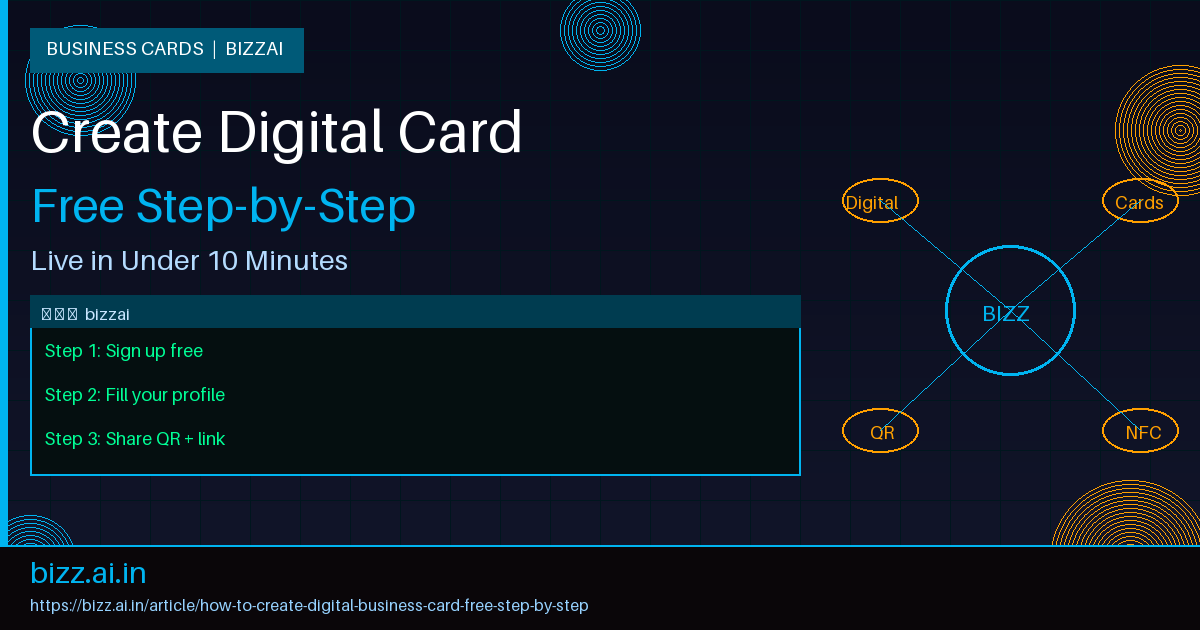
How to Create a Digital Business Card for Free (Step-by-Step)
Creating a digital business card for free takes under 10 minutes. This step-by-step guide walks through sign-up, profile setup, design, QR code generation, and sharing — so your card is live and working today.
Read article →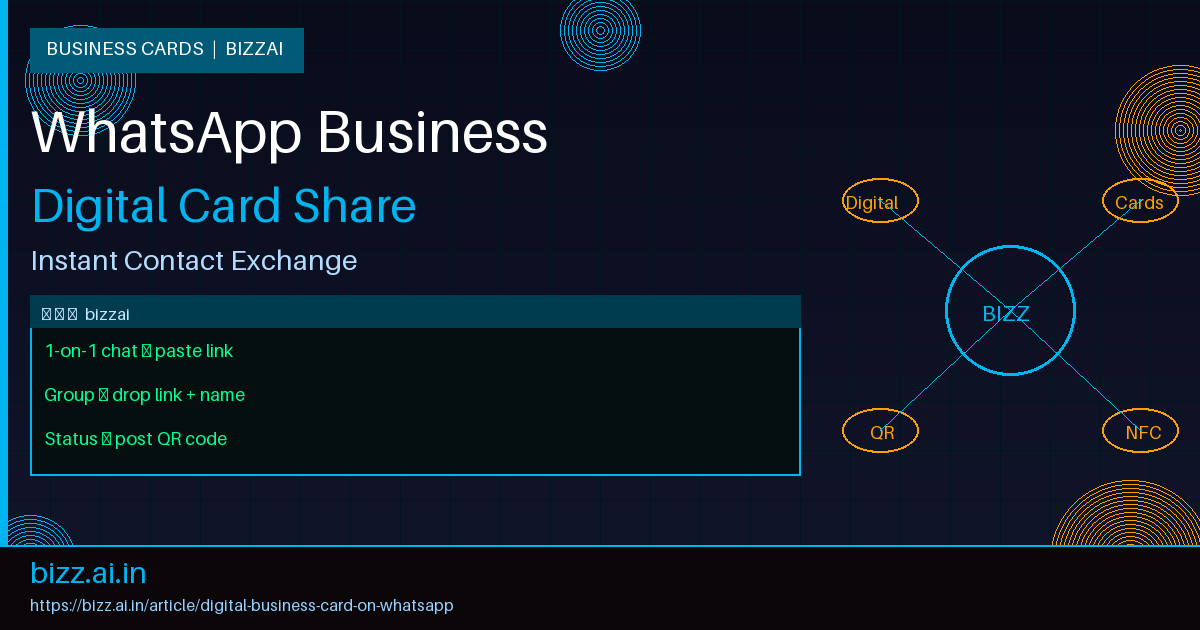
Digital Business Card on WhatsApp: Share Your Contact Instantly
WhatsApp is the primary professional networking channel in India. This guide shows you exactly how to share your digital business card via WhatsApp — in chats, groups, Status, and Business profiles.
Read article →