Business Digital Card vs Paper Cards
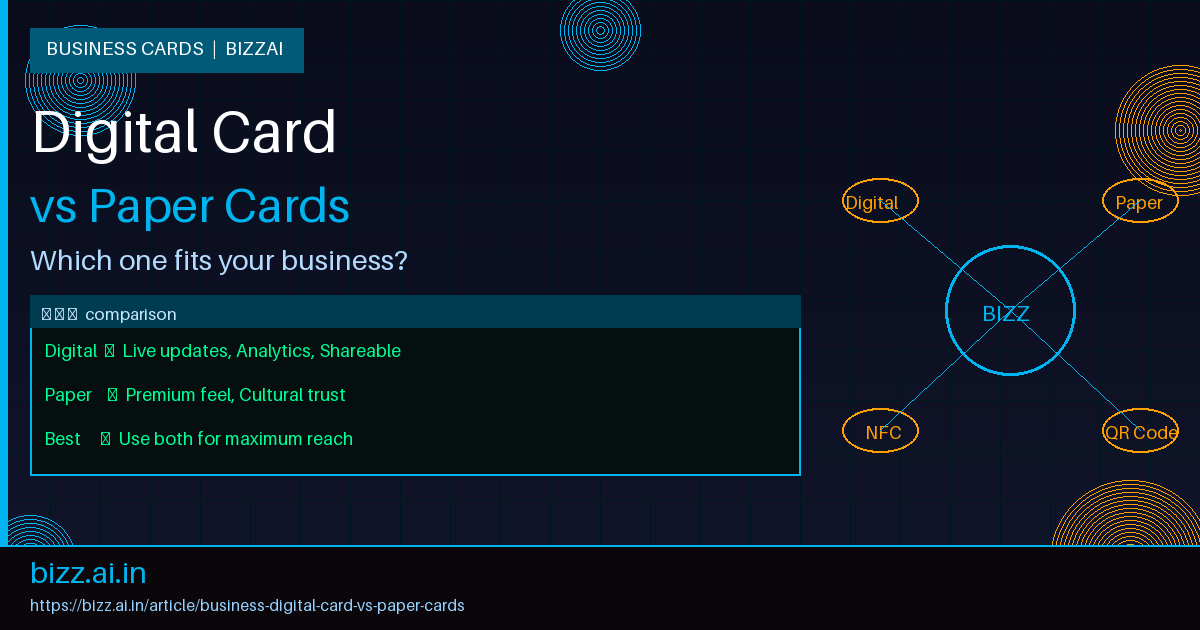
Digital business cards and paper cards each have a place in modern networking. This guide breaks down cost, sustainability, shareability, analytics, and first impressions so you can decide which format — or which combination — works best for your business.
Introduction
The business card has been a networking staple for centuries. At its core, it solves a simple problem: how do you hand someone your contact details in a way they will actually keep? For most of that history, the answer was a small rectangle of card stock, printed with your name, title, phone number, and company logo. But in the last decade, a credible alternative has arrived — the digital business card — and professionals everywhere are now asking whether the paper card has had its day.
The honest answer is: it depends. Digital cards offer genuine advantages in cost, reach, analytics, and environmental impact. Paper cards still carry weight in certain industries, cultures, and first-impression scenarios where handing over a physical object matters. Most professionals operating at scale will eventually conclude that both formats have a role — but understanding when and why each one wins is essential before you commit budget, time, or brand identity to either.
This guide walks through every meaningful comparison — cost, sustainability, shareability, updatability, tracking, and professionalism — so you can make a deliberate decision rather than defaulting to habit or chasing novelty.
What Are Paper Business Cards?
A paper business card is a printed card — typically 85 mm × 55 mm in most markets — containing your name, job title, contact details, company name, and logo. They have been a professional norm since at least the 17th century, when visiting cards carried social status as much as contact information. Today they remain the global default in most industries, from finance and law to real estate and manufacturing.
Modern paper cards come in dozens of variants: standard coated card, uncoated matte, soft-touch laminate, spot-UV gloss, letterpress, foil-stamped, die-cut shapes, and even metal or wood substrates. A well-designed, well-printed paper card communicates brand quality in a way that a URL on a screen genuinely struggles to replicate at first glance. The tactile dimension — the weight of the card, the texture of the finish, the precision of the print — is part of the message.
The core limitation of paper cards is equally fundamental: they are static, physical, and disposable. Once printed, the information cannot change. Once handed over, you have no idea what happens to it. And for every card that ends up pinned to a notice board or scanned into a CRM, several more end up in a desk drawer or a bin.
What Are Digital Business Cards?
A digital business card is an electronic profile — typically a webpage, a QR code, or an NFC-enabled device — that delivers your contact information to another person's phone without any physical exchange. Formats range from simple QR codes linking to a vCard download, through dedicated apps that generate shareable profile links, to NFC-enabled cards or wristbands that transfer data on tap.
The best digital card implementations let the recipient save your details directly to their phone contacts without typing anything, view your LinkedIn profile, book a meeting, or visit your website — all in a single tap or scan. Your profile is live, which means you can update your phone number, title, or employer at any time without reprinting anything. And because the interaction is tracked, you can see exactly who viewed your card, when, and what they clicked.
Digital cards vary considerably in quality. A basic free-tier QR code linking to a plain vCard is technically a digital card, but it delivers a very different experience from a professionally designed NFC profile with a custom domain, brand colours, and integrated booking links. As with paper cards, quality matters — and quality costs money, whether that is design time or a subscription.
Cost: Upfront and Over Time
Paper cards carry a clear upfront cost: design (if you do not do it yourself), print, and delivery. A basic order of 500 standard cards from a quality printer typically runs between ₹500 and ₹2,500 depending on finish, or £15–£60 in the UK market. Premium finishes — foil, letterpress, soft-touch — can push the cost of 500 cards to ₹5,000–₹15,000 or more. And that cost recurs every time you run out, change your details, or rebrand. For a sales team of twenty people, each refreshing cards twice a year, print costs add up to a meaningful line item.
Digital cards have a different cost structure. Many platforms offer free tiers that cover basic QR code sharing. Paid plans — which unlock custom domains, analytics, team management, NFC cards, and CRM integrations — typically cost between ₹500 and ₹2,000 per user per year, or around $5–$20/month per user on international platforms. The NFC physical card itself (a one-time purchase for each team member) generally costs ₹1,000–₹4,000 per card.
Over a three-year horizon, a professional who prints quality paper cards twice a year is likely spending more on cards than on a mid-tier digital card subscription — and the digital card will have delivered analytics, unlimited updates, and zero waste in the same period. For teams, the economics shift even more decisively toward digital at scale.
Environmental Impact
The sustainability case for digital cards is straightforward. The global business card industry produces an estimated 10 billion paper cards per year. Industry surveys consistently find that the majority of those cards are discarded within a week of receipt. The paper, the printing chemicals, the packaging, and the transport all carry environmental cost — and most of that cost is incurred for a card that ends up in landfill.
Digital cards eliminate the physical production entirely. There is still an environmental cost — the servers hosting the profile consume electricity — but it is orders of magnitude smaller than print runs at scale. For organisations with sustainability commitments or ESG reporting requirements, switching to digital cards is a visible, easy-to-communicate action that contributes to measurable reductions in paper and chemical consumption.
That said, environmental impact is not zero for digital. Manufacturing the NFC cards or devices that accompany many digital card solutions involves plastics and electronics. If you replace your NFC card every year, the impact case weakens. The greenest digital card solution is a QR code that lives on your phone — no physical object required at all.
Shareability and Reach
A paper card can only be shared in person. You must be present, you must have cards with you, and the other person must be physically in the same location. For planned networking events this is fine. For spontaneous connections — a conversation on a plane, a Zoom call with a new contact, a LinkedIn message thread — paper offers nothing.
Digital cards work in every channel. You can share your card link via WhatsApp, email signature, LinkedIn message, or SMS. You can embed a QR code in a presentation slide or a Zoom background. You can add your card link to your email footer and reach every person you correspond with, whether or not you have ever met them in person. The reach is genuinely unlimited in a way that paper never can be.
For professionals who do significant remote work or international networking, digital cards solve a real problem. Shipping paper cards internationally is expensive and slow. A digital card shared via a link works identically whether the recipient is in the same room or a different country.
Updateability
This is one of the starkest differences between the two formats. A paper card is frozen at the moment of printing. If you change your phone number, get promoted, move to a new company, or update your email address, every card you have ever distributed becomes inaccurate. You cannot reach back and correct the cards sitting in other people's wallets, desks, or CRMs.
A digital card is live. Update your profile once and every link that has ever been shared with anyone immediately reflects the change. A contact who received your card two years ago and looks you up today will see your current title, current number, and current email — without you having done anything beyond updating your profile. In careers where job changes, promotions, and company pivots are common, this is not a convenience feature. It is a genuine professional asset.
Analytics and Follow-Up
Paper cards offer no analytics. Once handed over, they disappear into the world and you have no signal about what happened next. You do not know if the recipient saved your number, visited your website, shared your details with a colleague, or binned the card immediately after the conversation ended. Follow-up requires memory, manual notes, or the discipline to log contacts in a CRM immediately — all of which are friction points that cost leads.
Digital cards change this entirely. Quality platforms show you when your card was viewed, how many times, what links were clicked, and in some cases where the viewer was located. You can see which networking events generated the most profile views, which contacts came back to look at your details a second time, and which referrals your existing contacts are generating by sharing your link. For sales professionals and business developers, this data has real commercial value. Knowing that a contact viewed your card three times in the 48 hours after a meeting is a strong follow-up signal that a paper card simply cannot provide.
First Impressions and Professionalism
This is where paper cards still hold meaningful ground. A beautifully printed, premium-finish paper card — thick stock, precise typography, tasteful design — communicates quality and intent in the moment of exchange. The ritual of handing over a card, particularly in formal business cultures across Japan, South Korea, China, and much of South Asia, carries social weight that a QR code cannot replicate. In some contexts, producing a physical card signals preparation, seriousness, and respect for the relationship.
Digital cards, done poorly, can go the other way. Pulling out your phone, fumbling through an app, and asking someone to scan a QR code can feel awkward, especially with older contacts or in formal settings. An NFC card tapped elegantly against someone's phone is slick and memorable — but it requires the recipient to have NFC enabled and to know what is happening, which not everyone does.
The honest assessment is that digital cards have largely closed the first-impression gap for most professional contexts, but paper still wins in formal, high-stakes, or culturally specific situations where the physical exchange is part of the professional protocol.
When Paper Cards Still Win
- Formal international business meetings — particularly in East Asian markets where the card exchange ceremony carries specific cultural weight.
- Industries where physicality signals trust — luxury goods, legal, finance, and architecture, where a premium physical card reinforces brand positioning.
- Older demographic audiences — where QR codes and NFC are unfamiliar and the friction of the digital exchange undermines the connection.
- Conferences and trade shows — where badge scanning and QR codes are already ubiquitous and a distinctive paper card can stand out by contrast.
- Brand moments — a beautifully crafted paper card can function as a mini brand experience that no digital equivalent currently matches.
When Digital Cards Are the Clear Choice
- Remote and hybrid professionals — who do significant networking over video calls, email, and social platforms where physical cards cannot be shared.
- High-volume networkers — sales teams, recruiters, and business developers who connect with dozens of new contacts weekly and need tracking and CRM integration.
- Professionals who change roles frequently — where the updateability of a live profile saves the cost and waste of reprinting after every job change.
- Sustainability-focused organisations — where eliminating print runs is a visible commitment to ESG goals.
- International networkers — who need to share contact details across geographies without physical logistics.
- Tech, startup, and digital-native industries — where producing an NFC card or QR code is itself a signal of being current and forward-thinking.
Can You Use Both?
For many professionals, the most practical answer is yes — but with intention. A common approach is to maintain a small stock of high-quality paper cards for formal, in-person situations where the physical exchange matters, while using a digital card as the primary tool for everyday networking, remote connections, and follow-up. Some professionals print a QR code linking to their digital card profile on the back of their paper card, effectively bridging both formats in a single object.
Teams can adopt a tiered approach: senior leaders who attend high-stakes client meetings receive premium paper cards and an NFC digital option; field sales teams who attend high-volume events use digital cards exclusively; remote staff use digital only. This gives the organisation maximum flexibility without committing the entire budget to a single format.
The key is to make a deliberate choice rather than defaulting to paper out of habit or chasing digital out of novelty. The right format is the one that serves the networking context and the audience — and for most modern professionals, that means having both available and knowing when to reach for each.
The Future of Business Networking
Digital cards are gaining adoption quickly, but paper has not disappeared and will not disappear soon. What is changing is the expectation around digital capabilities. As NFC becomes standard in more phones, as QR code literacy increases across age groups, and as remote work normalises digital-first networking, the friction points around digital card sharing are reducing year by year.
The next generation of digital cards is moving toward deeper integrations: automatic contact enrichment, AI-powered follow-up suggestions, direct CRM logging, and multi-channel sharing analytics. These capabilities widen the gap between digital and paper for professionals who care about conversion, not just connection. Meanwhile, paper cards are trending toward higher quality and smaller print runs — fewer cards, but each one more considered — as a luxury and brand-positioning tool rather than a volume networking mechanism.
For businesses building a networking strategy today, the pragmatic position is to invest in a strong digital card setup as the primary infrastructure, and to reserve budget for quality paper cards only in the specific contexts where they genuinely add value that digital cannot match. That is not a compromise — it is the most effective use of both formats.
Frequently Asked Questions
Q: Are digital business cards professional enough for senior executives?
A: Yes, in most contexts. A well-designed digital card on a custom domain, shared via NFC or a clean link, is entirely appropriate for senior professionals. In formal cultural contexts — particularly Japanese or Korean business meetings — a premium paper card remains the more appropriate choice. Many executives maintain both and choose based on the situation.
Q: What happens if the recipient does not have a smartphone?
A: This is a genuine limitation of digital-only approaches, though it is a shrinking one. If you know you will be networking with audiences who may not have smartphones — certain industries, older demographics, or specific markets — keeping a supply of paper cards is wise. A hybrid approach covers all bases without requiring you to choose one format exclusively.
Q: Can digital business cards be shared without internet access?
A: NFC-based digital cards work without internet access for the tap-to-share interaction, but the recipient will need connectivity to load the profile page linked from the NFC chip. QR code solutions similarly require the scanner to have internet access to load the destination page. For fully offline environments, paper is still the only reliable option.
Q: How do I choose the right digital business card platform?
A: Key factors to evaluate are: custom domain support (does your card URL look branded or generic?), analytics depth, CRM integrations, team management features if you have staff, NFC card availability, and mobile app quality. Free tiers are useful for testing but typically lack the analytics and customisation that make digital cards genuinely more powerful than paper.
Q: Do digital business cards work at trade shows and conferences?
A: Very well, especially via QR code displayed on a phone or badge insert. Many professionals at tech and startup conferences now exchange digital cards exclusively. However, at traditional trade shows in conservative industries, paper cards still dominate, and arriving without them can seem unprepared. Know your audience before committing to digital-only at an event.
Q: What information should I include on a digital business card?
A: At minimum: full name, current job title, company name, phone number, email address, and a website or LinkedIn URL. Beyond the basics, digital cards can include a photo, social profile links, a short bio, a booking calendar link, a WhatsApp direct link, and even a video introduction. The ability to include this richness without space constraints is one of the genuine advantages digital has over paper.
Q: How secure are digital business cards?
A: Reputable platforms use HTTPS for all profile pages and do not expose your data to unauthorised parties. The main privacy consideration is that analytics-enabled cards log who views them and when — which is a feature for you but means recipients should be aware their viewing activity may be tracked. For sensitive roles, this is worth noting in your card's privacy disclosure.
Q: Can I use a digital business card if my company has strict branding guidelines?
A: Yes. Most paid-tier digital card platforms support full custom branding — your logo, brand colours, typography, and a custom domain (e.g. card.yourcompany.com rather than a generic platform URL). Enterprise plans typically include brand administration controls so the marketing or brand team can enforce consistency across all employee cards.
Q: Is it worth investing in NFC cards rather than just QR codes?
A: NFC offers a smoother recipient experience — tap to share, no camera needed — but requires an NFC-capable device on the receiving end, which is now standard on most modern smartphones. QR codes are universally compatible and cheaper to deploy but require the recipient to open their camera. For premium networking contexts, NFC cards feel more polished. For maximum compatibility, QR is the safer choice.
Q: What are the best paper card finishes for a premium impression?
A: Soft-touch laminate (a velvety matte finish), spot-UV gloss on a matte base, letterpress on thick uncoated stock, and foil stamping are consistently the strongest premium finishes for first-impression impact. Thickness matters too — cards below 350 gsm can feel flimsy. For the highest-impact paper card, invest in 400–600 gsm uncoated stock with a letterpress or foil finish in a limited print run.
Q: How do I manage contacts collected via digital business card shares?
A: Most quality digital card platforms offer CRM integration — pushing new contacts directly into HubSpot, Salesforce, Zoho, or similar on share. If your platform does not offer this, export your contacts as a CSV regularly and import manually. The analytics dashboard also gives you a timestamped list of every share and view, which makes follow-up prioritisation significantly easier than managing a stack of paper cards after an event.
Q: Should startups use digital or paper cards?
A: For most startups, digital-first is the stronger choice — lower cost, immediate updatability (critical when job titles and contact details change rapidly in early-stage companies), and the analytics that help small sales teams prioritise limited follow-up time. A small run of high-quality paper cards for investor meetings or formal pitch presentations is worth the investment alongside a digital setup, but printing thousands of paper cards for a team whose details will change in six months is rarely good value.
Conclusion
The debate between digital and paper business cards is not really a contest with a single winner. It is a question about context, audience, and what you are trying to communicate. Paper cards remain powerful tools in specific situations — formal meetings, premium brand positioning, cultural contexts where the physical exchange is meaningful. Digital cards are superior across the majority of modern networking scenarios: lower long-term cost, live updates, unlimited shareability, real analytics, and zero waste.
For most professionals today, the right answer is a strong digital card setup as your primary networking tool, with a small supply of premium paper cards reserved for the contexts where physical matters. That combination gives you maximum reach, measurable results, and the flexibility to meet any networking situation on its own terms.
Stop choosing between digital and paper. Choose the right format for the room you are in — and make sure you are ready for both.
Related articles
Visiting Card Size in India: mm, Inches, Bleed and Pixels
The visiting card dimension in India is not officially standardized, but certain sizes are commonly used by printers. Sparsh Media notes that 90 mm x 54 mm is the predominant size in India, while other popular sizes include 89 mm x 51 mm and 85 mm x 55 mm. Printers offer templates for these sizes to ensure your...
Read article →
How to Create a Digital Business Card for Free (Step-by-Step)
Creating a digital business card for free takes under 10 minutes. This step-by-step guide walks through sign-up, profile setup, design, QR code generation, and sharing — so your card is live and working today.
Read article →
Digital Business Card on WhatsApp: Share Your Contact Instantly
WhatsApp is the primary professional networking channel in India. This guide shows you exactly how to share your digital business card via WhatsApp — in chats, groups, Status, and Business profiles.
Read article →